Friday, 12 September 2014

Goluchow


Located in a picturesque park on the River Trzemna, the Gołuchów Castle attracts visitors by its exquisite Renaissance architecture and charming interiors.

The building was erected in the 2nd half of the 16th c. as a property of the Leszczyński family. In the mid-19th c. it became a property of Izabela (daughter of Prince Adam Czartoryski) and Jan Działyński.


The sculpture-studded yard offers a spectacular view of the park. It is good to have a short rest here to enjoy this landscape before visiting the Castle and take a stroll in the park after completing the tour of the building.


The character of the venue owes much to Izabela, who set up an exquisite collection of art works and converted her residence into a museum.


The objects presented in the Gołuchów branch of the National Museum: sculptures, artefacts of ancient cultures, and original red-figure Greek vases are but a fragment of Izabela Czartoryski’s extensive collection, regrettably dispersed today.

Goluchow Castle
The history of the Goluchow Castle on the Trzemna river dates back to over 400 years ago. Initially it was the seat of the Leszczynski family, whose heyday as an imposing residence of magnates came to an end at the close of the 17th c.


In 1853 the Goluchow estate was purchased by Tytus Dzialynski, the owner of the Kórnik estate, for his only son Jan. After the marriage of Jan Dzialynski and Duchess Izabella Czartoryska, daughter of Duke Adam Jerzy Czartoryski, Goluchow was to become the residence of the newlyweds. Unfortunately, the property was sequestered in retribution for Jan Dzialynski's participation in the January Uprising.


In the early 1870s it became the sole property of Jan's wife Izabella. It was thanks to her that the building was restored by architects, sculptors and painters from France, among others by Charles Biberon, Louis Breugnot and a young architect Maurice August Ouradou, Eugene Viollet-le-Duc's son-in-law. While numerous details characteristic of the Polish Renaissance castle were preserved, the entire property was rebuilt in the style of French Renaissance, patterned on the famous Loire valley castles.


Most of the sculptures decorating the yard were 16th and 17th-century French and Italian originals purchased by Izabella Dzialynska in antique shops. She intended to make Goluchow not only a residence but also a museum.


 The castle is picturesquely surrounded by a landscape park, the biggest in Wielkopolska, covering an area of ca.160 hectares, with a collection of a few hundred species of trees and shrubs. Originally, next to the castle there was a small Italian-style garden. A little farther away were peasants' quarters and a forest. As soon as Jan Dzialynski became the owner of the estate, he started to create a park with collections of trees and bushes shipped from every corner of the world. The unique features of the landscape made Jan Dzialynski establish an English-style park. Since ca. 1876 landscaping work on site was supervised by the gardener Adam Kubaszewski.


In the park, next to the castle, there is the so-called Annex, a residence of the Dukes Czartoryski until World War II, currently the Museum of Forestry, and a chapel where Izabella Dzialynska was buried in 1899. Care of the park and the remaining buildings is provided by the Centre for Forestry Culture in Goluchow.

http://www.euromuse.net/en/museums/museum/view-m/zamek-w-goluchowie/


Mice's Tower in Kruszwica


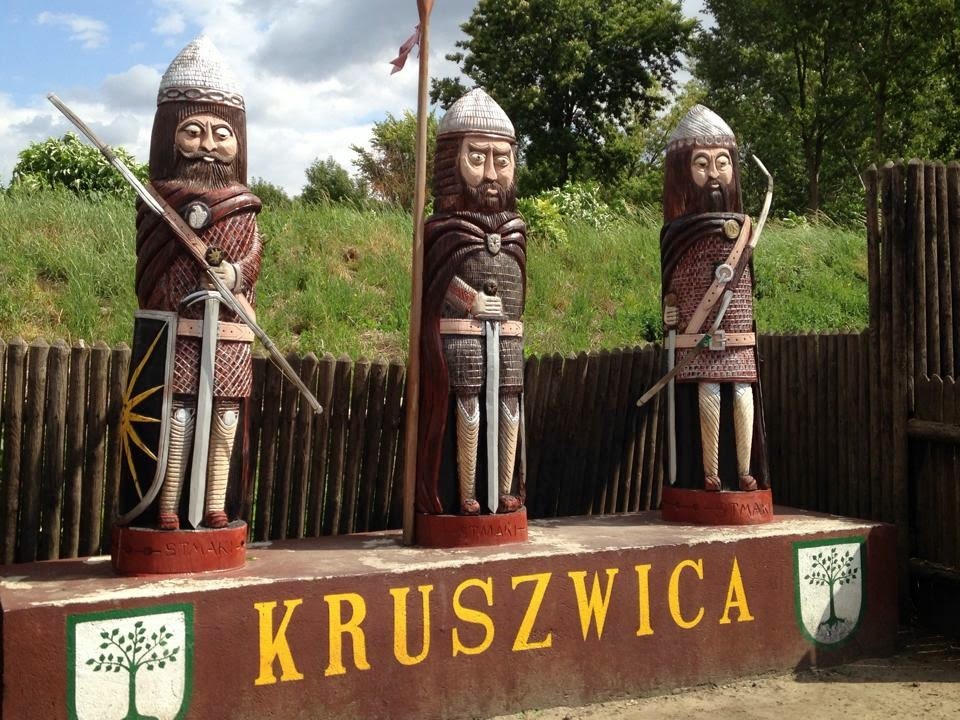
A town situated in the Kujawy-Pomerania Province, District (powiat) of Inowrocław, ca. 16 km south-east of Inowrocław. Kruszwica is an important point on the Piast Route.

The Former Castle of Kruszwica

South-east of the Market, the Mouse Tower dominates the Lake area landscape; situated at the base of Rzępowski Peninsula which cuts into Gopło Lake, it is a relict of the castle erected in mid-14th century by King Casimir the Great. 

In 1656, the castle was seized by the Swedish army which burnt it down as they were retreating. In the late years of 18th century, the castle ruins were gradually dismantled and its bricks floated up the Noteć river to Inowrocław. Only one of the towers has survived – octagonal, 32 m in height – along with fragments of walls adjacent to it. During excavation works carried out in 2nd half of 20th century, a number of other fragments of the castle and movable objects of historic interest were discovered. In the northern part of the castle hill, relics of an early-mediaeval burg-city were found: wooden huts with clay threshing floors and hearths; clog-lined streets; numerous pieces of equipment; ornaments and implements (incl. e.g. glass beads, amber products, clay vessels, bronze and iron products). 

The Mouse Tower is the main tourist attraction of Kruszwica. You can climb up to its top using the wooden stairs, to see a wide view from there, encompassing the town and the Nagdoplański Millennium Park. At the tower’s foot is a haven for ‘Rusałka’ promenade ship. A festival ‘At Piast’s and Popiel’s Place’ is held in mid-July, offering historical shows, demonstrations of crafts of yore, fighting scenes, plebeian amusements and Viking boat cruises. The building located east of the Tower (also having a tower) houses an exhibition showing the castle of yore and the output of archaeological works.


http://regionwielkopolska.pl/en/catalogue-of-attractions/mouse-tower.html


Bygdoszcz - New - Old City


Bydgoszcz /ˈbɪdɡɒʃ/ (Polish pronunciation: [ˈbɨdɡɔʂt͡ʂ] ( ),GermanBromberg [ˈbʁɔmbɛʁk] ( )LatinBydgostia) is a city located in northern Poland, on the Brda and Vistula rivers. With a city population of 363,926 (March 2011), and an urban agglomeration with more than 470,000 inhabitants, Bydgoszcz is the 8th-largest city in Poland. It has been the seat of Bydgoszcz County and the co-capital, with Toruń, of the Kuyavian-Pomeranian Voivodeship since 1999. Prior to this, between 1947 and 1998, it was the capital of the Bydgoszcz Voivodeship, and before that, of the Pomeranian Voivodeship between 1945 and 1947.Bydgoszcz, originally Bydgoszcza (feminine gender word), is created as a pronoun name, the second part of which – goszcz comes from gost-jь possibly or gost-ja an old Slavic root which refers to an urban or suburban trading settlement. Other examples of this include the German 'Trebgast' in Bavaria, which until 1028 was known as Trěbigost-jь, Radogost-jь, in Austria, is also a prominent example; it is today known as Ratgoz. There are also a number of other Polish place names which make use of the goszcz suffix: Małogoszcz and Skorogoszcz. Bydgoszcz, however, has a long, rich history of etymological change:
  • 1239, Bidgosciam
  • 1242, castrum quod Budegosta vulgariter nuncupatur (castle, which is colloquially called Bydgoszcza)
  • 1279, Bidgoscha
  • 1558, Bydgoszcz, that is, until the 16th century, Bydgoszcza "fishing village or campsite belonging to Bydgosta"
The name Byd-gost contains archaic elements of the Proto-Slavonic root 'byd' which existed as a variant of the verb 'to raise' ( Ancient Russian vъzbydati = stimulating, Proto-Slavonic bъděti / bъd 'ǫ = no sleep, to watch),[1] and the common Slavic root Goszcz (fireplace). Some people identify the name of the town as Budorgis, a name from the 2nd century which is listed next to the village Calisia on the amber route.


Master Twardowski

Brda River and Man crossing the river


http://en.wikipedia.org/wiki/Bydgoszcz

polish + - drinks and .... foods))))


Wroclaw up side down


Tyskie Browarium


http://www.tyskiebrowarium.pl/en/

Tyskie /ˈtɪskjə/ (Polish pronunciation: [ˈtɨskʲɛ]) is one of the best selling brands of beer in Poland, with around 18% of the Polish market. Tyskie distributes its beer worldwide, and in 2010 and again in 2012 was the most served and bought beer in Europe[citation needed]. Tyskie is produced by Kompania Piwowarska, itself a subsidiary of SABMiller established in Poland in 1999 as a result of the merger of two SABMiller owned Polish breweries, the Lech breweryin Poznań, and the Tyskie Górny Śląsk brewery in Tychy.


Wenecja - RailwaY Museum


In 1972 a Museum of the Narrow-Gauge Railway was founded in Wenecja (Polish for: Venice), right next to the ruins of the "Devil's Castle" there, by a group of Pałuki Regiondevotees based in the town of Żnin. During the tourist season the Museum began running a special passenger rail link from Żnin to Gąsawa via Wenecja and Biskupin (>>). Racing through the picturesque fields and by the lakes at the breath-taking speed of up to 20 km per hour, its trains carry from ninety to one hundred thousand Polish and foreign tourists every year.

The railway station in Wenecja has a stylish, late 19th century waiting room. It is the train engines, however, that are the Museum's key attraction. Especially interesting is the oldest, an Orenstein-Koppel engine from 1899, as well as a tiny engine made by the Charles company of Belgium in 1935, one of ten such produced. There is also a complete train pulled by a Tx26-422 locomotive built in Poland's first Locomotive Factory in Chrzanów in 1926. The train's passenger carriage contains an exhibition of railway uniforms, railway lamps, objects used by station staff and ticket inspectors, and of the interiors of passenger and mail carriages. The cargo carriage displays railway tools and items related to narrow gauge train technology. There is also an interesting late nineteenth century carriage for the transport of mail and dogs.
i